Heat pumps are now regarded as the all-rounders of modern heating technology. They use free environmental energy, operate efficiently, are comparatively inexpensive to run and make an important contribution to climate protection. It is therefore no surprise that around one in two new buildings now uses a heat-pump system, and the number continues to rise. The right control strategy is essential to run heat pumps efficiently.
As convincing as using nature as an energy source may sound, one point is equally important: A heat pump can only realise its full potential when the entire heating system is optimally matched to it. Homeowners and tenants often underestimate this crucial factor. Older heating systems were commonly designed according to the principle that bigger is better, but different rules apply to heat pumps.
Why steady running times are so important
A heat pump is particularly efficient when it achieves long, steady running times. Every start consumes a disproportionate amount of electricity and places additional strain on the equipment. If the heat pump constantly switches on and off, a behaviour known as cycling, both energy consumption and wear increase. Avoiding this is therefore essential for efficient operation.
To prevent cycling, the generated heat must be transferred continuously into the heating system. Surface heating systems such as underfloor heating are ideal in principle because they can absorb large amounts of heating water. In practice, however, most underfloor heating systems use a simple open-or-closed principle. A heating circuit is either fully open or fully closed. Control with conventional thermal actuators can quickly prevent the heat pump from releasing its energy and force it to cycle.
Motorised actuators enable optimal and efficient underfloor-heating control
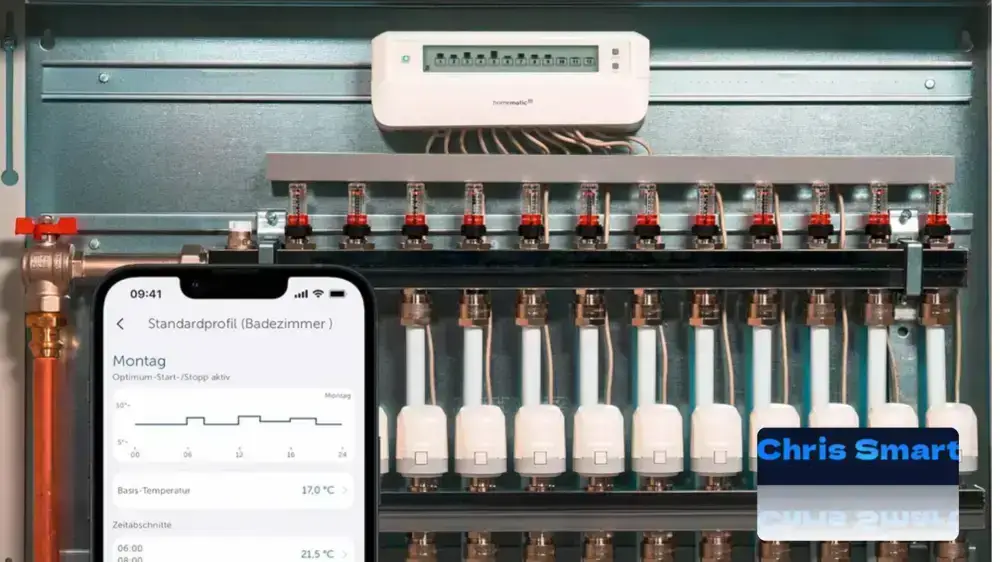
Motorised actuators provide a solution by allowing continuous control of the heating-water flow. Combined with an intelligent Homematic IP underfloor-heating controller, the flow of heat through the individual heating circuits can be controlled much more precisely. The controller is installed directly in the heating-circuit manifold, where it manages the entire underfloor-heating system.
Instead of only opening or closing the heating circuits completely, motorised actuators can adjust the valve position precisely. This creates a steady flow that improves comfort and, above all, reduces the load on the heat pump. It cycles less frequently and can modulate its heat output more effectively.
The Fraunhofer Institute for Energy Economics and Energy System Technology confirmed this advantage in a measurement campaign . Its results show that continuous control significantly reduces heat-pump cycling, thereby increasing efficiency and extending service life.
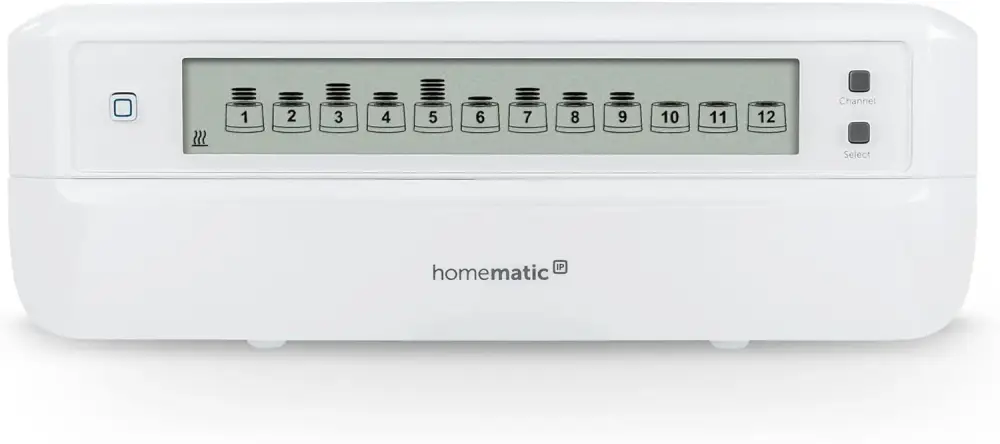
Homematic IP Smart Home underfloor-heating controller
12 channels, motorised, digital underfloor-heating control
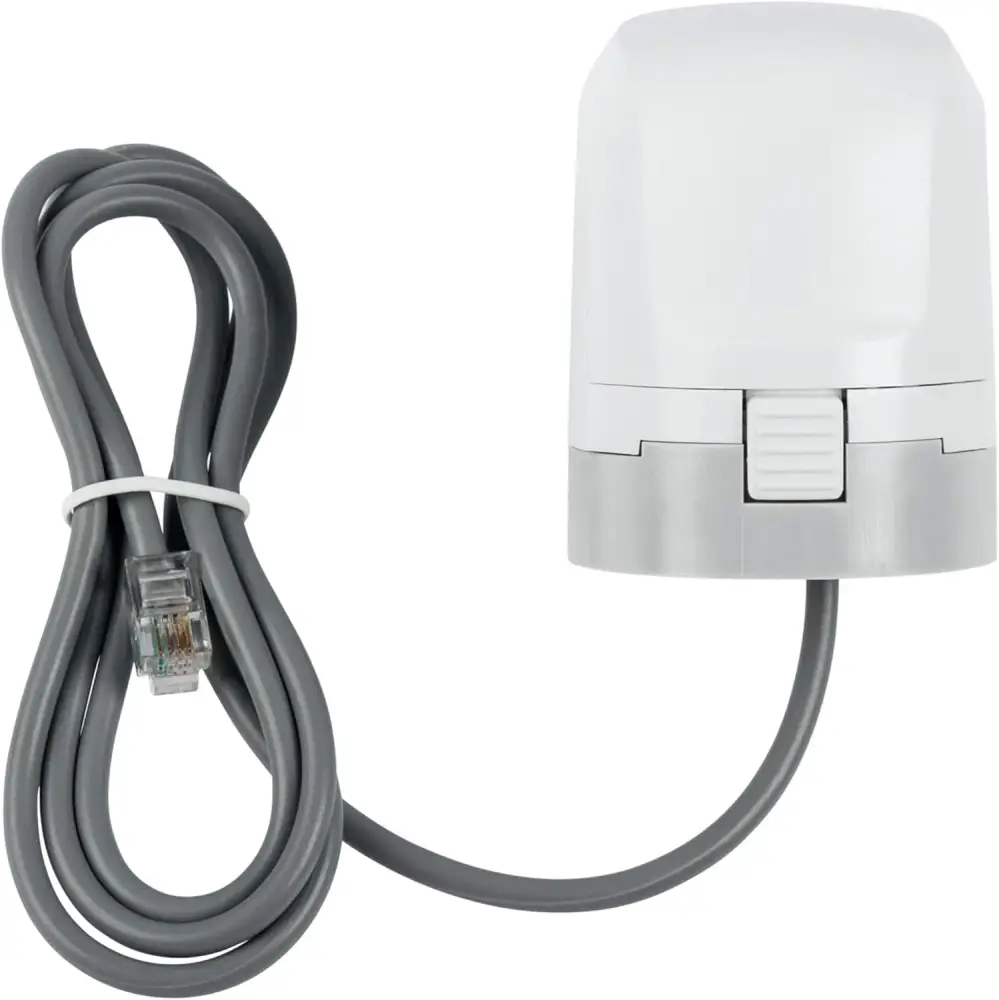
Homematic IP actuator for underfloor heating
compatible with the Homematic IP underfloor-heating controller
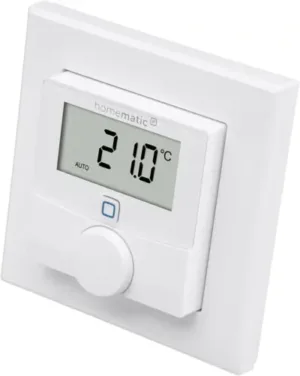
Homematic IP Smart Home wall thermostat
humidity sensor, digital thermostat for radiators and underfloor heating
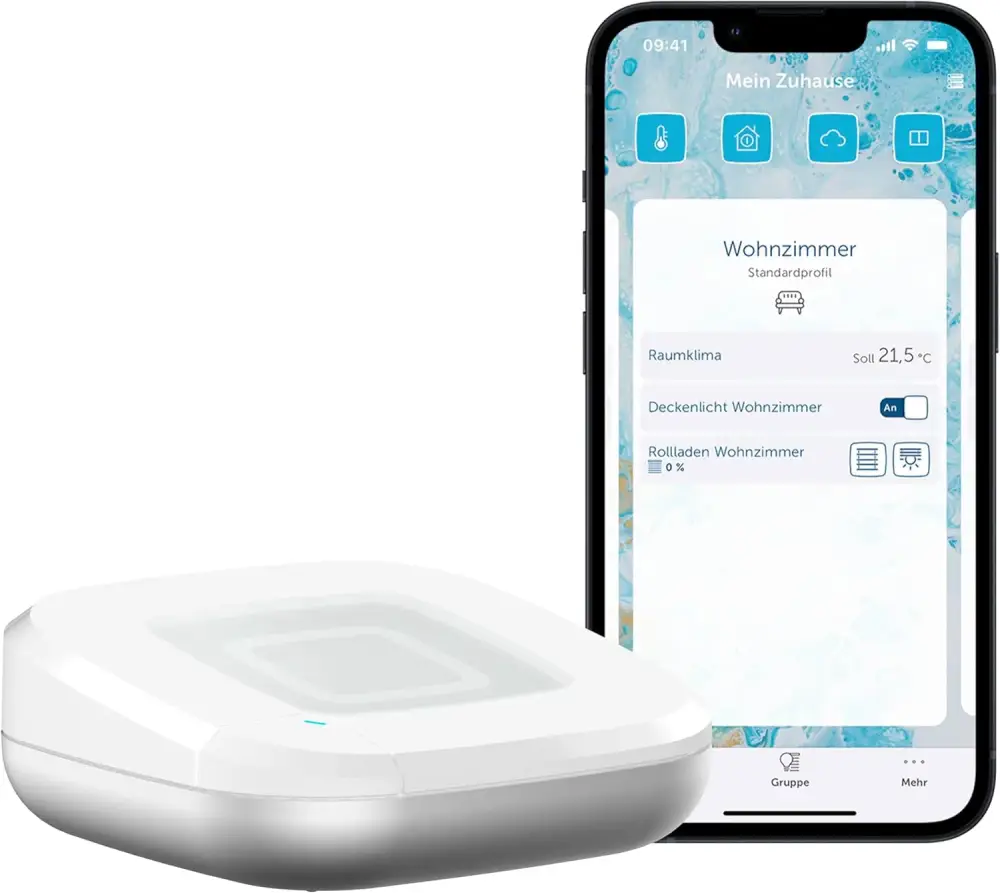
Homematic IP Access Point 2
smart-home gateway with free app and voice control via Amazon Alexa
Improve heat-pump efficiency systematically
Another factor that is often overlooked is the flow temperature. Raising the flow temperature by one kelvin can reduce a heat pump’s efficiency by up to 2.5 percent. Lowering it by just 10 degrees can therefore cut energy consumption by as much as 25 percent.
The Homematic IP underfloor-heating controller also helps here because it continuously displays the valve positions of the individual heating circuits. If the valves are not at their upper limit, the flow temperature can be reduced without making rooms uncomfortable. This increases efficiency and saves real money.
Smart-home integration and automation
The system becomes even more convenient and efficient when the heating control is part of a smart-home system such as Homematic IP. The underfloor-heating controller can be integrated easily through a Homematic IP control unit or an Access Point and controlled locally or remotely with the app. Control via a smartwatch is also possible.
Each room can use individual heating profiles that vary by time of day and day of the week. The bathroom can be comfortably warm in the morning and evening while the temperature is reduced during the day to save energy. Other components can also be linked: roller shutters can close automatically to prevent heat loss or provide shade in summer. If required, the heat pump itself can even switch to cooling mode automatically.
Technical background: how heat pumps work
The principle of a heat pump resembles that of a refrigerator, only in reverse. A special refrigerant extracts heat from the environment, whether from the air, ground or groundwater. A compressor compresses and strongly heats the refrigerant. It then transfers its heat to the heating system before cooling again as the pressure drops and the cycle starts over.
The heating curve, which controls the flow temperature according to the outdoor temperature, is crucial for operation. Two parameters play the main role: the slope determines how sharply the flow temperature rises as the outdoor temperature falls, while the parallel shift sets the heating system’s overall temperature level. Precise heating-curve adjustment is an important way to keep energy consumption low.
Conclusion
The heat pump is one of the most efficient and sustainable heating technologies available today. Yet it can only realise its full benefits in combination with intelligent control technology, motorised actuators and a smart underfloor-heating controller. Steadier running times, lower flow temperatures and smart-home integration deliver greater efficiency, more comfort and lower costs.
Heat-pump technology glossary
Delivery temperature / flow temperature
The temperature at which heating water is fed from the heat generator, such as a heat pump, into the heating system. A low flow temperature increases heat-pump efficiency.
Underfloor heating
A surface heating system in which warm water flows through pipes embedded in the floor. It distributes heat evenly and operates at low flow temperatures, making it ideal for heat pumps.
Heating curve
A heating-control setting that defines how the flow temperature changes in relation to the outdoor temperature. Adjusting the slope and parallel shift helps optimise energy consumption.
Underfloor-heating controller
An intelligent Homematic IP underfloor-heating controller* that can control up to 12 motorised actuators. It optimises heat distribution, prevents cycling and increases heat-pump efficiency.
Hydraulic balancing
A method that ensures every heating circuit receives exactly the right amount of heating water. Without balancing, some rooms become too warm while others remain too cold, wasting energy.
Seasonal performance factor (SPF)
A measure of heat-pump efficiency. It is calculated from the heat delivered in relation to the electricity used. For example, an SPF of 4 means that 1 kWh of electricity produces 4 kWh of heat.
Refrigerant
A fluid with special thermodynamic properties that absorbs environmental heat in the heat pump, evaporates, is compressed and then releases the heat to the heating system.
Motorised actuator
A small electric-motor drive that can regulate the valve position in a heating circuit continuously, allowing precise control of the heating-water flow.
Cycling
Frequent switching of the heat pump on and off. This behaviour is inefficient, increases electricity consumption and shortens the unit’s service life.
Thermal actuator
A simple drive for heating-circuit valves that works according to an open-or-closed principle. It cannot regulate the valve position precisely and often causes cycling problems with heat pumps.
Flow temperature
The temperature of the heating water pumped from the heat pump into the heating circuits. Low values significantly improve efficiency.
Heat pump
A heating system that uses roughly 75% environmental energy from air, ground or water and around 25% electrical energy to provide heat. It works like a refrigerator in reverse.
Source/photo: (Amazon /Homematic IP)

Ich bin Christian und habe den Blog 2024 gegründet. Ich bin gelernter Kommunikationselektroniker, technikbegeistert und Smart-Home-Enthusiast mit langjähriger Erfahrung im Bereich vernetzter Haushaltsgeräte. Mit großer Leidenschaft verfolge ich aktuelle Entwicklungen und teste regelmäßig neue Produkte, um verständliche Einblicke und praxisnahe Empfehlungen zu geben.