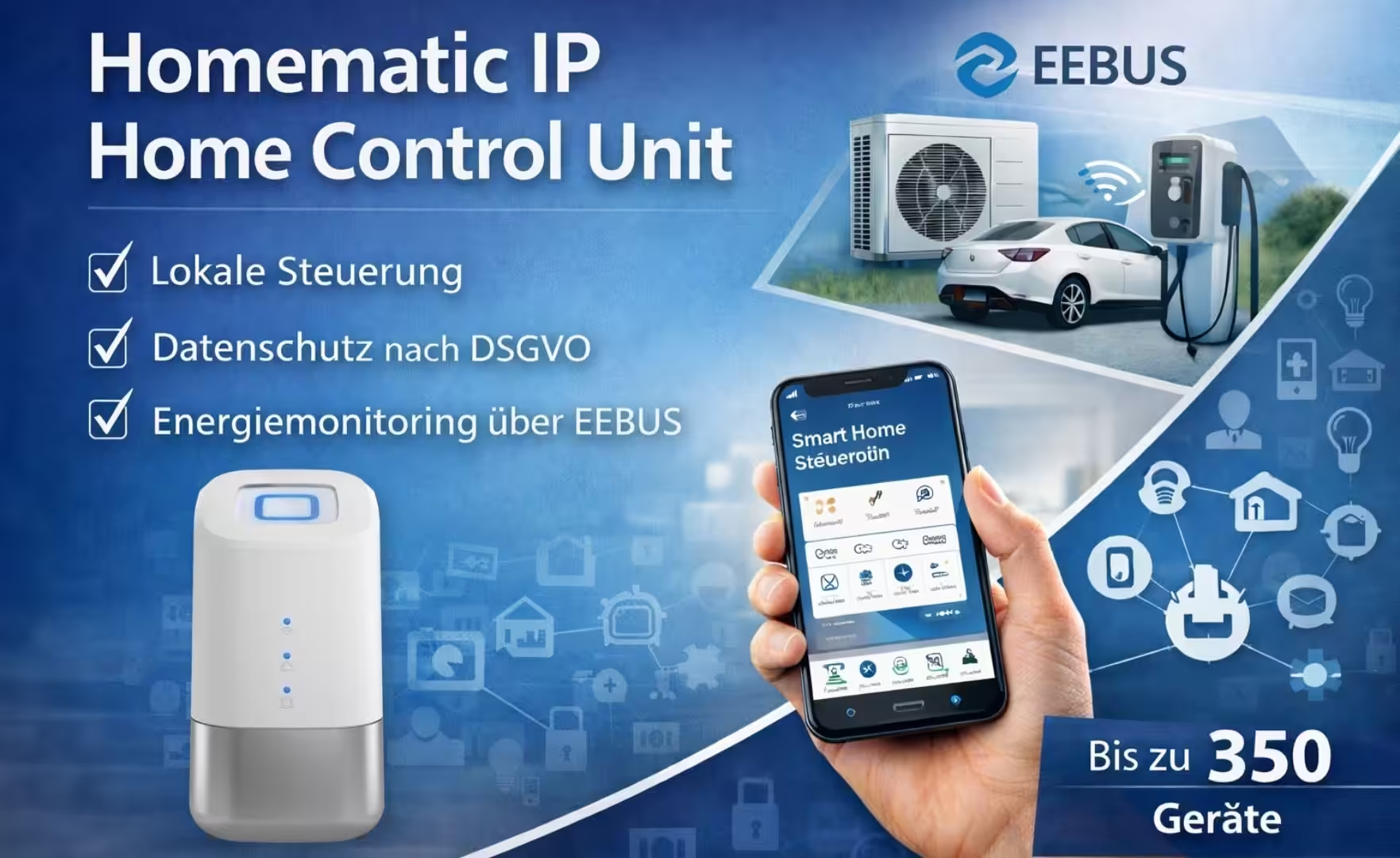
With the Home Control Unit, Homematic IP intends not only to control heating, lighting and security in the future, but also to take on a role in energy management. eQ-3 plans to achieve this by integrating the EEBUS plugin and adding the LPC and LPP functions, which can automatically limit the power consumption of loads and the feed-in power of generating systems.
We have already presented the control unit and its local functions in detail in our article about the Homematic IP Home Control Unit. At that time, the EEBUS integration was primarily used to collect and analyze measurement data; future control of compatible devices had merely been announced. With the new functions, Homematic IP is now at least partially fulfilling that promise.
What happens to a heat pump, wallbox or photovoltaic system when the grid operator temporarily specifies a power limit? The Home Control Unit is then intended to distribute the available power selectively among the connected devices. Users can decide for themselves which loads receive priority.
What is EEBUS?
EEBUS stands for “Energy Efficiency Bus.” It is a manufacturer-independent communication standard for energy management. Put simply, EEBUS enables energy devices from different manufacturers to speak the same “language” and exchange measurements and control commands.
The Home Control Unit uses this interface to communicate with compatible energy devices on the local network. In its instructions, Homematic IP mentions heat pumps, wallboxes, inverters, smart meter gateways and control boxes, among other devices. Measurements such as consumption and feed-in are then displayed in the energy dashboard of the Homematic IP app.
LPC and LPP: what the abbreviations mean
LPC stands for “Limitation of Power Consumption” and applies to devices that draw electricity, such as heat pumps, air-conditioning systems and wallboxes. LPP means “Limitation of Power Production” and is intended for systems that generate energy or feed it into the power grid.
When a power limit becomes active, the system does not simply switch off the connected devices completely. Instead, it reduces their power. The app can be used in advance to determine which devices receive higher priority. For example, the heat pump could be ranked above the wallbox. Charging power for the electric car would then be reduced earlier and more substantially. Exactly how a device responds depends on its supported functions and the individual installation.
EEBUS alone is not enough
Setup takes place via the EEBUS plugin in the local HCUweb interface. The connection must then be confirmed both in the interface or app of the respective energy device and in the Homematic IP app. The devices must support EEBUS and be on the same network as the Home Control Unit.
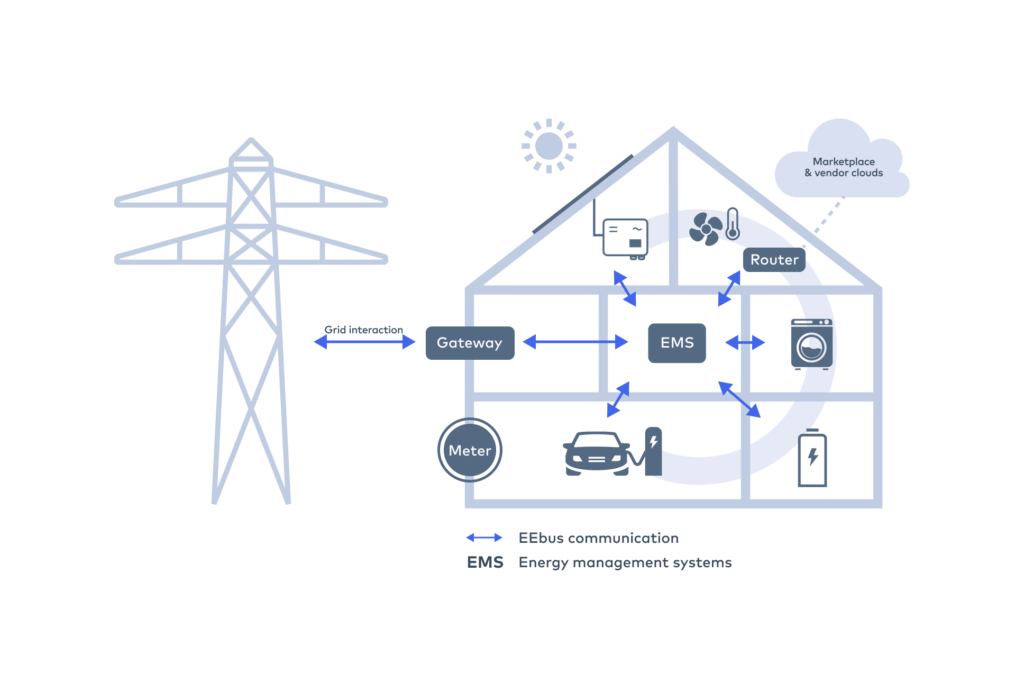
For actual power limiting by the grid operator, suitable control technology—such as a CLS gateway with an FNN control box—and correspondingly controllable devices are also required. A Home Control Unit and an installed plugin alone are therefore not sufficient.
If all requirements are met, EEBUS communication can replace additional relay wiring. Whether an existing device is fully compatible and supports the new functions should be checked with its manufacturer beforehand.
The background: Section 14a EnWG and Section 9 EEG
The new functions are related to German legal requirements for controllable consumption devices and generating systems. Since January 1, 2024, newly installed controllable loads with a grid connection capacity of more than 4.2 kW must be capable of reducing their power when necessary. These include private wallboxes, heat pumps, air-conditioning systems and certain electricity storage systems.
If the local power grid is at risk of overload, the grid operator may temporarily reduce their power consumption. According to the German Federal Network Agency, a minimum power of 4.2 kW remains available. Normal household electricity is not affected by such throttling. In return, operators of a controllable consumption device can benefit from reduced grid charges.
With LPP, Homematic IP also takes into account possible requirements for limiting generation and feed-in, which the manufacturer references in connection with Section 9 EEG.
Energy management is set to become a paid service from 2028
Homematic IP provides an important note with the launch: the LPC and LPP functions can be used free of charge until December 31, 2027. After that, they are to become part of a paid Home Energy Management System (HEMS).
According to the manufacturer, there will be no automatic switch to the paid service. No information is yet available about the price or exact scope of functions of the future HEMS.
Conclusion
The new LPC and LPP functions are a useful step for the Homematic IP Home Control Unit. Instead of merely displaying energy flows, the control unit can now respond to a specified power limit and prioritize compatible devices in an order chosen by the user.
This can be interesting for households with a heat pump, wallbox, photovoltaic system or storage system—provided that all components involved support the necessary communication. The main open questions are how much the announced HEMS will cost from 2028 and which additional functions it will offer.
Source/photo: (Amazon /Homematic IP /EEBUS plugin how-to / Gridx)


Ich bin Christian und habe den Blog 2024 gegründet. Ich bin gelernter Kommunikationselektroniker, technikbegeistert und Smart-Home-Enthusiast mit langjähriger Erfahrung im Bereich vernetzter Haushaltsgeräte. Mit großer Leidenschaft verfolge ich aktuelle Entwicklungen und teste regelmäßig neue Produkte, um verständliche Einblicke und praxisnahe Empfehlungen zu geben.